Must Love Dogs
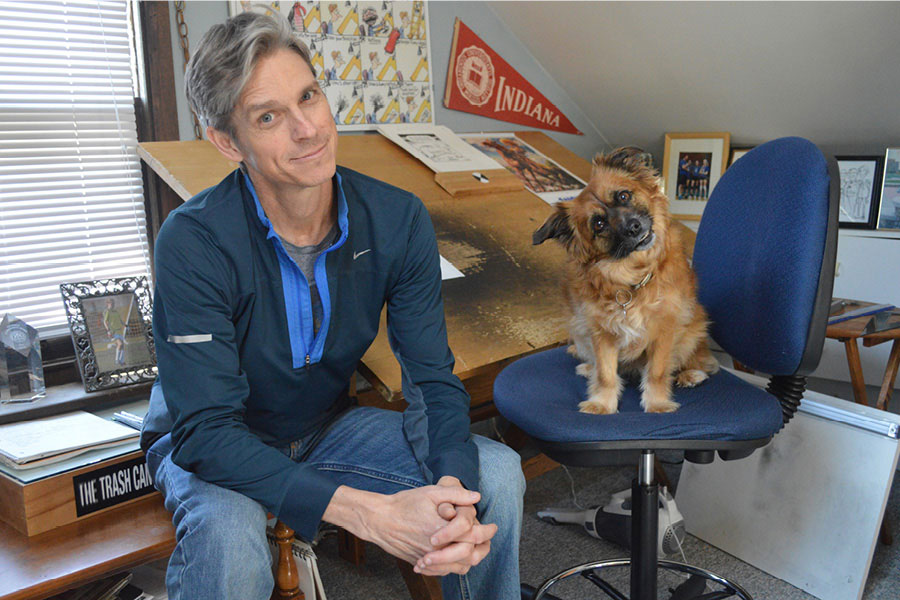
Dave Coverly, MA’93, is the creator of the cartoon panel Speed Bump, which runs internationally in hundreds of newspapers and websites, including The Washington Post, the Los Angeles Times, The Globe & Mail (Toronto), and the Detroit Free Press. His work was named “Best in Newspaper Panels” by the National Cartoonists Society in 1995, 2003, 2014, and 2022.
The self-taught artist cut his teeth on the comics in The New Yorker, and his earliest works ran in his middle and high school publications. Then came a strip called Freen—about a guy and his pet lizard—which he published in the Eastern Michigan University newspaper, The Eastern Echo, while he pursued a double major in philosophy and imaginative writing. Freen also ran in the Indiana Daily Student while Coverly attended graduate school at Indiana University Bloomington and won several awards in the late 1980s.
Now based in Ann Arbor, Mich., Coverly notes his time in Bloomington helped to set him on his unique path. “I [worked on my master’s degree] a little bit at a time, because that was kind of when the cartooning started kicking in,” he says. Besides his work for the IDS, Coverly created political cartoons for the Herald-Times newspaper.
In the following Q&A, Coverly, who is also highlighted in the Spring 2026 IU Alumni Magazine, talks about his love of cartooning and dogs—and how the two combine to create some of the funniest single-panel cartoons around.
You double majored in philosophy and imaginative writing as an undergraduate at Eastern Michigan University and did a master’s degree in creative writing at IU. At what point in your life, did you think that you wanted to do what you do now?
Dave Coverly: I always say, if I’d been a dentist, I would come home and do cartoons at night. I really enjoy it. I enjoy the process so much. I mean, I’ve been doing it for, what, 33 years now syndicated. And I still look forward to—I still really love the whole feeling of having a blank page, and then, you know, three days later, you get seven cartoons drawn. And just that—the idea of creation I find not just exciting, but just really fulfilling. It scratches an itch that I would have to scratch no matter what else I was doing. So, I’m just extraordinarily lucky to do this for a living, obviously.
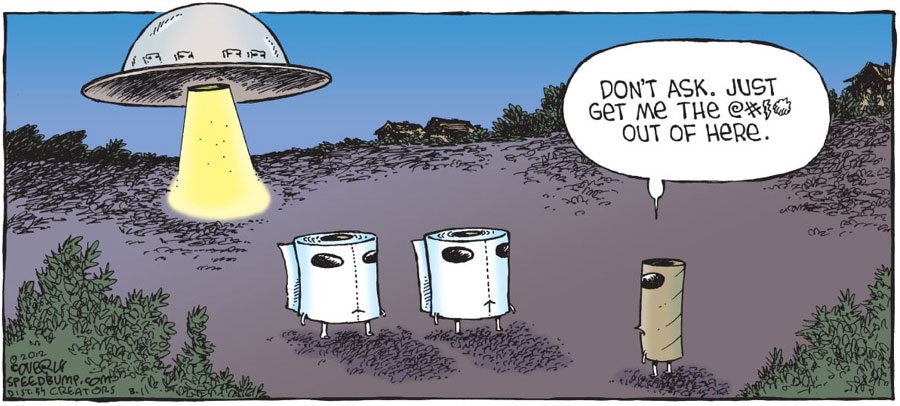
You do everything in a single panel. You don’t give yourself the crutch of several boxes. It’s like one crystallized rectangle, and you’re in and out like a ninja, and then it’s over!
DC: I don’t think I could even draw a comic strip. I like—I love—drawing single-panel jokes. That’s my favorite thing in the world to do. And, so, the fact that I get to do not just cartooning, but the very, very specific type of cartooning I want to do is just—I’m just grateful to the universe that it worked out that way.
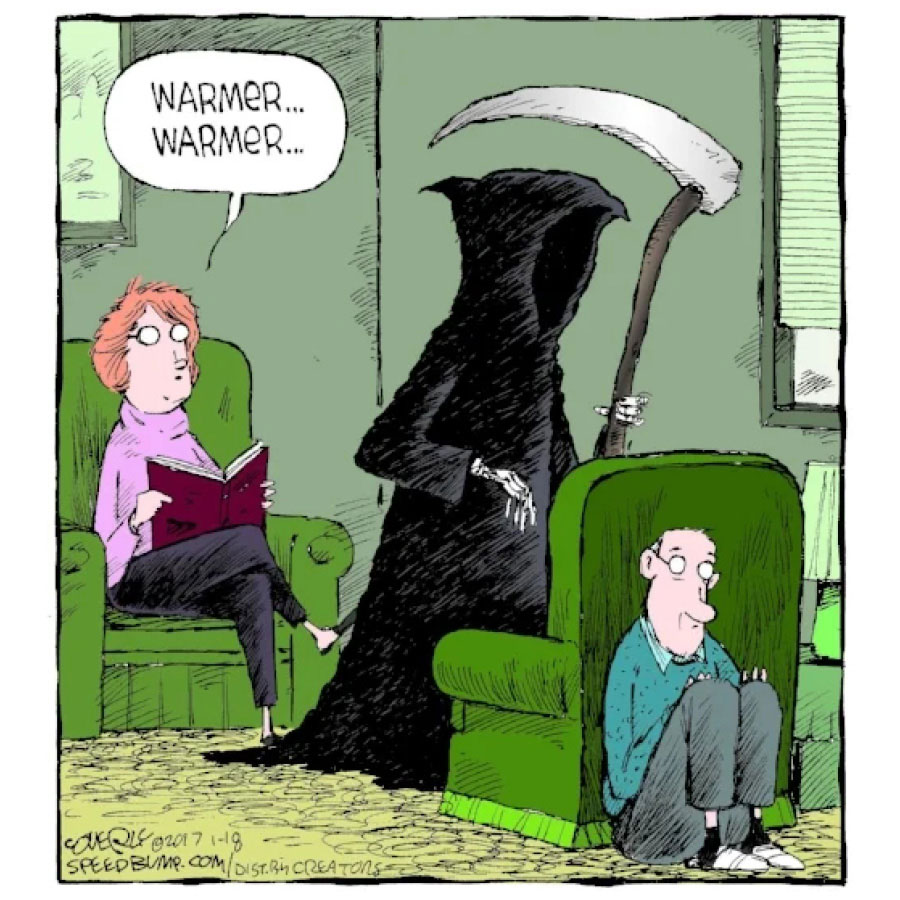
They’ve done studies [on] people who read cartoons—on average, they’ll read a cartoon for six seconds. So, if you can’t get your joke across in six seconds—you know, sometimes mine are probably seven or eight seconds. I kind of like that. I like subtle humor. That’s the stuff I grew up reading in The New Yorker. Cartoons that really made you stop and think for a second. And you have that pause and then you go, “Oh!” and, you know, then you get it. I enjoy those kinds of jokes. I know some people prefer to have a joke hit you over the head, but I like the more subtle, nuanced ones that are about something. They’re not just a joke. They’re about something.
Does anything that happens externally in the world ever make it very difficult for you to find humor or levity or joy that you can then put into your rectangle to pass along to the rest of us?
DC: That is the perfect question. I have to tell you—you just went to the heart of my job, because it’s impossible for the world not to affect how your work goes. My biggest personality trait that helps me is that I have an ability to compartmentalize something. I’m lucky that I can sit and just think, like, “OK. Part of my job is to not think about that.” And, so, part of being a professional—my job is to separate those things. What is still relevant? What is still funny? What do people still have in common? What are we talking about when we’re not talking about that? Because you need a break from it. I feel like part of my job is to provide a break from it.
And, also, on a micro level, you know, things will happen to me personally or specifically that don’t happen to the world, obviously. Like my dog passing away. It took me a couple of weeks after my dog passed away, because, you know, she was the greatest thing ever. And I just couldn’t think of jokes. I was just too sad, you know. Sometimes you just can’t.
Have you always had dogs? Other pets? Cats?
DC: Always dogs. Ever since the third grade, I’ve had a dog in some capacity until the last few years.
You clearly understand their behavior, and it’s fun how you use animals as sort of stand-ins for people.
DC: The reason it works—two reasons—is that people love animals. I mean, obviously. And then, I just think dogs are the best thing ever invented. I love dogs. I love drawing dogs. I like thinking about dogs, so it works out.
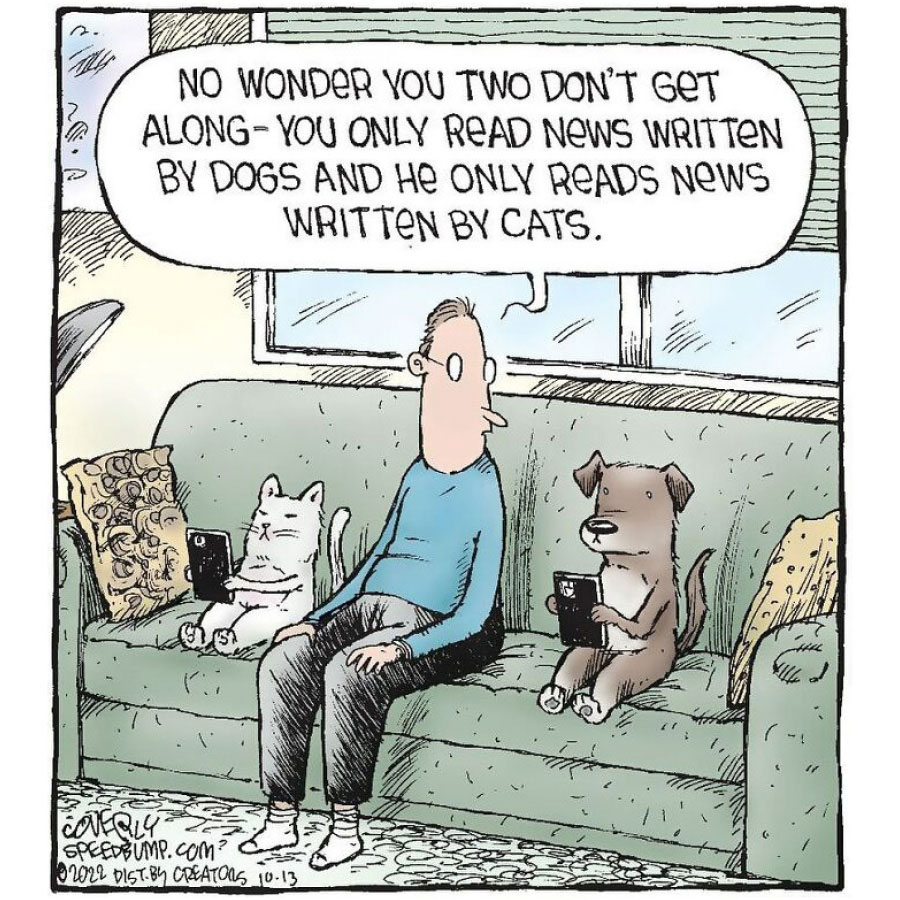
But, also, you can say things about the human condition with a buffer. You can do it with dogs doing something that people do that is not so direct. You’re not talking about people at this point. That little disconnect makes it funnier. It’s kind of another sideways “in” to how we behave.
I feel like that’s most of my job. The cartoons are about how we behave, the absurd things that we do, or the things that we care about that are—why do we care about that? So, you can say that in a less pointed way by having a dog say it, instead of having a person say it. I think the nicest thing anybody said about my work was that they thought it was very gentle.
What does your creative process look like? Do you start with a rectangle on a blank page? Do you just doodle? How does that work?
DC: It’s very specific maybe to me, but I sit down with just a notepad—a good, lined notepad—and I don’t draw at first. I sit and I don’t think about jokes even. I think that’s one of the misunderstandings about people who do humor. The jokes aren’t coming sort of fully formed. You know, you’re not at the grocery store looking at Cheerios and you get a Cheerios joke. It just doesn’t happen that way, at least for me.
I always start out with subject matter. Like, what’s it going to be about? What’s something that people are talking about, or what’s something we have in common like getting notifications updates on your phone or something like that. I start there. Then, I sort of let it go sideways. So, you’ve got a couple dogs—what would they need notifications about? And then, the hard thing is that you let your mind wander, but not so far that you’re thinking about dinner or whatever. You sort of get in this organized daydreaming kind of mode, letting your mind wander.
What you’ve described is almost like a meditative state, at least as far as the idea-noodling part goes. That’s not an easy thing to accomplish. I can see why, once you’re in there, you want to knock out a few comics. Because every time you’re interrupted, it would be a Herculean task to get back to where you were.
DC: It is so hard! That’s why I set aside certain chunks of time that can’t be interrupted. When the kids were younger, I’d be up here in the mornings, and that would just be like, “Leave Dad alone from 8 a.m. to lunch.” It’s like I need that four hours of quiet to just sit and think. But, when I’m drawing, they’d be up here … playing around or drawing with me or whatever. That was great.
You have a new book coming out. How many does this make in total?
DC: I’ve got 15, and I have a new one coming out so this will be the 16th. My new collection of latest dog cartoons is coming out with Andrews McMeel Publishing. It’s coming out early fall. It’s called My Support Dog Ate My Comfort Food. That should be out, I think, September or October.
Final question: What do you hope to accomplish in the future?
DC: I mean, first, I’m just thrilled that I’ve done this for over 30 years and made a living, you know, and put my kids through college and stuff, doing exactly what I wanted to do. My goal is maintaining that. I’d like to do this for as long as the world will let me. And I know that won’t be forever, but I enjoy it so much. I’m not trying to set the world on fire. I’m not trying to get in every paper or sell a million books, but, man, if I could just continue doing what I’m doing, I’d be thrilled.
Someday I’m hoping I’ll be 90 and I’ll be looking back—I have all of these original cartoons up here, like, 15,000 cartoons I’ve drawn. And, one day, I hope to look at those stacks of cartoons and think, “Yeah, that’s what I did.” That would make me very happy.
Written by
Susan M. Brackney
Susan M. Brackney, BA’94, has been a professional writer since 1995. A member of the American Society of Journalists and Authors, she has written four nonfiction books, including Plan Bee: Everything You Ever Wanted to Know About the Hardest-Working Creatures on the Planet.