One-on-One with Coach DeVries
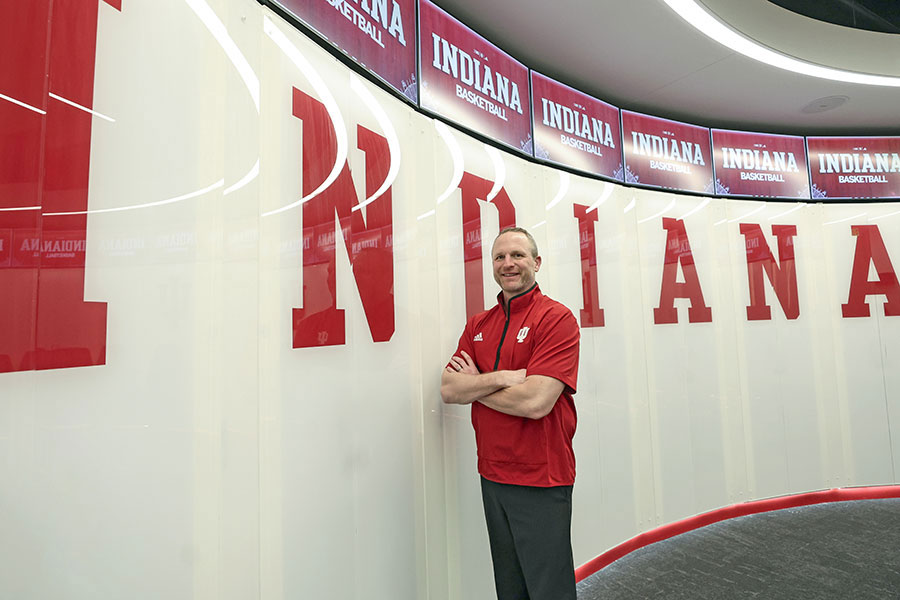
In March 2025, Indiana University named Darian DeVries the 31st head coach of the Hoosier men’s basketball team. “We went into this coaching search with some very specific things we were looking for,” said IU Vice President and Director of Intercollegiate Athletics Scott Dolson, BS’88, “and Darian emerged as someone who, on paper, met and often exceeded our criteria. Once we had a chance to talk to him, we knew we had the right person.”
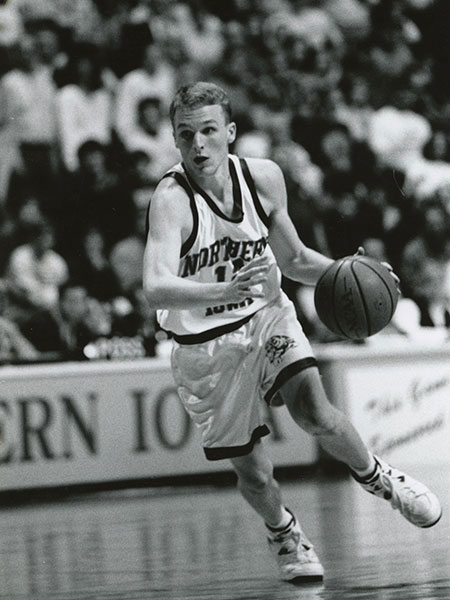
DeVries played football and basketball in high school and went on to the University of Northern Iowa, where he played basketball for the Panthers. Photo from University of Northern Iowa Special Collections & University Archives.
DeVries, a former collegiate player himself, comes to Bloomington with more than 24 years of Division 1 coaching experience, 15 NCAA Tournament appearances as a head coach or as an assistant, and a reputation of righting the ship for struggling programs—most recently in the Big 12 at West Virginia University.
Even with his already impressive résumé, DeVries acknowledges and respects the prestige that comes with taking the helm of Hoosier basketball.
“This is unquestionably one of the top jobs in America. As someone who grew up in the Midwest loving the game of basketball, I’ve always admired IU basketball for its championship-level success, tradition, and fan support,” says DeVries. “There’s a passion to succeed at the very highest levels both within the Big Ten and in the NCAA tournament, and that’s a desire that as a coach I share.”
We spoke with DeVries in August 2025 to learn more about IU’s newest Hoosier.
Welcome to Hoosier Nation! How has Bloomington been treating you so far?
Darian DeVries: It’s been good. The first couple months are a little bit of a blur, but now that I have a team and coaching staff assembled, there’s a little more normalcy. I’ve been able to get out in the community, not only with our team and coaches, but with my family. It’s been nice that it slowed down and we’ve really been able to enjoy being here.
When the team takes the court this season, what can fans expect? How would you describe a DeVries Hoosier team?
DD: What I hope they see is a team that’s really connected and a team that plays incredibly hard every night—that they play together well, and that they play with incredible enthusiasm. That’s what I think our group is to this point. I’m excited for them to get out on the court and for our fans to see them play.
What is your coaching philosophy?
DD: Number one, it’s trying to have a philosophy that’s consistent on a daily basis with what we’re trying to achieve. That’s how we get from point A to point B and get there in a manner that produces the results that we all intend. We’re very much a process-oriented program, and it’s incredibly valuable to make sure that we’re always thinking about the little things first. It all equates into big things at the end.
How has your approach evolved through your years of coaching?
DD: I got a chance to work for Dana Altman for a lot of years at Creighton and Greg McDermott, who was head coach at Drake University. I think with every team and every coach, you take little bits and pieces—you’re always evolving not only from year to year, but even during the season. It’s all about figuring out how to get each roster to maximize its potential. Each year you get a little more direction on where you want it to go and how you want it to get there.
We’ve really developed this up-tempo, fast-paced practice mentality, and that’s how we want to represent ourselves on the game floor. We’re trying to get ourselves to that point through practices—trying to be very efficient in everything we do on the practice floor.
You just mentioned a couple of names—looking back, who have been the major influences on your coaching career?
DD: McDermott and Altman are two of the best that have ever done it, and they both do it to their own personalities. I’ve been very fortunate in that way to learn from them as well as a lot of great assistant coaches that I’ve worked with through the years. They’re all part of helping you evolve as a coach.
Everybody always thinks it’s about the coaches you work with, but I’ve also learned a lot from players along the way. It’s part of evolving as a coach—you learn what motivates or sometimes you learn that you need to do it differently the next time.
Speaking of players, how would your players describe your coaching style?
DD: I think our players would say we’re attentive to the details in our culture and what things look like on a daily basis. Our players understand that in order for me to get the most out of them, I have to have a great relationship with them. I’m here to help them in every way possible, not just on the basketball floor.
When you have that level of trust, it starts from the very first time you talk to them in recruiting. We make sure that we’re very honest and upfront with them, so when they get here, they understand our relationship is built on trust. Then collectively we can both achieve what we want to at the end of it.
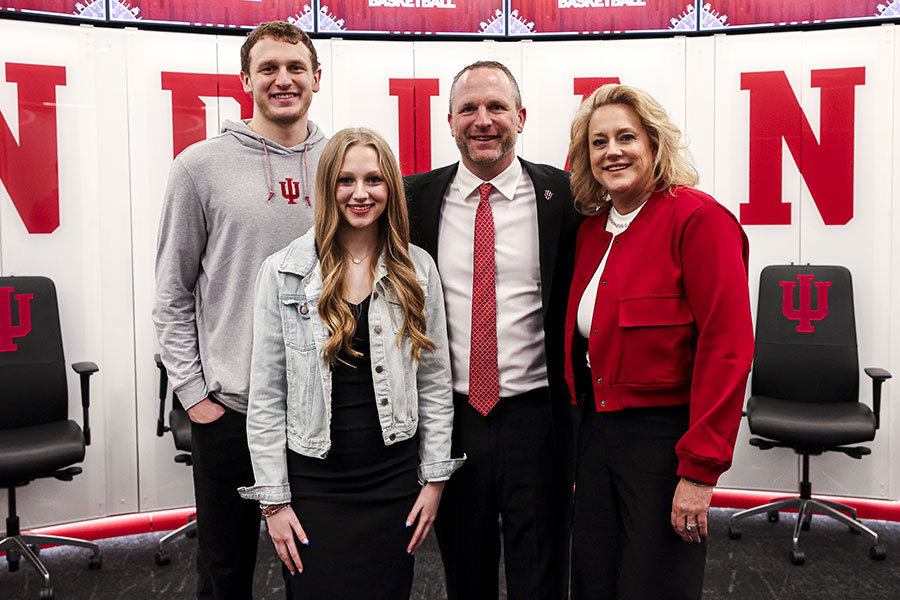
Coach Darian DeVries with his wife, Ashley; son, Tucker; and daughter, Tatum, at the family’s introduction to Hoosier Nation at Simon Skjodt Assembly Hall on March 19, 2025. Photo by IU Athletics.
I’m thinking of one player in particular, your son, Tucker. What is it like coaching him at this level?
DD: We’ve really enjoyed it. It’s been an awesome experience. When your kids are growing up and you’re in this profession, you miss out on a lot. Getting a chance to coach him gets some of that time back. From the road trips to the day-to-day stuff like practices, that’s the piece I know I’ve enjoyed the most. It’s certainly something I know that five to 10 years from now we’ll look back and talk about what a great experience it was.
When is the last time you played Tucker one-on-one?
DD: His freshman year of college. And I don’t let him win; I foul [laughs]. I retired immediately after that one though [laughs].
The team had the opportunity to go to Puerto Rico this summer. What went well there? What were some areas for improvement?
DD: There was a lot that we learned. We got to do some excursions, so we learned that some guys are better at kayaking than others [laughs]. I thought overall it was an awesome experience for us, and with the non-basketball stuff, the guys really enjoyed themselves. They were able to be around each other in a different setting, which I think helps build those relationships and those bonds.
Then on the basketball floor, we got really challenged in two of the three games, which was terrific. It showed us the things that we need to work on when we get back, but also some things we’re really doing well and need to continue to emphasize. It was a great experience both on and off the floor.
Looking ahead, what are some of your goals for your first season?
DD: I think the main thing was building the roster to make sure that we get started with the right guys in our locker room and the right culture. And I think we’ve done that. I love the guys we have; I love their approaches and the ways they interact. I got to see it firsthand in Puerto Rico—the way they interact with our fans who were able to make the trip, and the way they interact away from [fans], like in restaurants, with the people who are delivering food, or whatever it may be. I’ve really been excited about that—the way they’ve been in the community.
I think we’re off to a great start and [the players are] a big reason why—we obviously haven’t even played a game yet. So that’s the main goal of this first season—to make sure we have the right guys. Now we can continue to build off that.
If we were to talk again in April, how would you define success for the season?
DD: I think success is measured in a lot of different ways. We’re judged as a team on wins and losses, but I know internally when I look back on a season, it’s always about did we maximize what we thought we could out of this group? When you get to the end of a season, you’re always going to look back at a game or two and think about what we could have done differently to change that outcome or what we did well throughout the course of the year. Then, like everything, it’s just continuing to try to get better at it.
So, for me, if we get through April and I feel good about how these guys performed on the floor, even on the nights where maybe the outcome wasn’t where we wanted but we still did it the right way, that’s success.
If sports were not an option, what would your career path have been?
DD: I was originally going to be a teacher—an elementary-school teacher and a high-school coach, so they would’ve gone to together. I really enjoyed being able to teach young kids. Being in the classroom, you never know what’s going to happen on a day-to-day basis. To me, that would’ve been a fun career path.
Describe your pre-game routine.
DD: I get here in the morning, get a workout in, and go through a little bit of film study with the staff before our pregame shoot around.
Then it’s just fine tune all your thoughts before you go over to the arena. You watch the clock tick until tip off. I think for coaches, that’s the worst part—those 90 minutes before the game tips off. It’s like, What do you do? The players are out there warming up, and you’re just sitting back in your office. A lot of times I’ll go out to watch warmups and talk to an opposing coach to take up some of that time.
How do you celebrate a big win?
DD: Very quickly [laughs]. Basketball happens fast, so same thing with losses. Losses are harder to shake, but with wins, it’s celebrate with the team, family, and friends, then it’s time to watch the film and get ready for that next game.
When you’re not working, how do you relax and unwind?
DD: I like to golf; spend time with my wife, daughter, and son; and watch movies or something on Netflix.
Our readers are the most loyal and connected IU fans—what kind of impact does their energy and support have on the program?
DD: One of the things that makes Indiana so special is our fans and the support they give. When they show up, they show up because they know they have an impact on winning and losing. When you have a fan base like we do, and fans who are as knowledgeable as ours, they understand how they can impact the outcome of games, especially at home. We have one of the best home-court settings in all of college basketball with 17,200 fans. The way they show up and are engaged is something pretty special.
DeVries Fast (Break) Facts
- Darian DeVries grew up on a family farm in Aplington, Iowa. He’s the oldest of five siblings.
- He played football and basketball in high school and went on to the University of Northern Iowa, where he played basketball for the Panthers.
- Following graduation from UNI, DeVries joined Creighton University as a graduate manager for three seasons. In 2001, he was named an assistant coach—a position he held until 2018.
- DeVries’s first head coaching job came in 2018 at Drake University. At the end of the 2018–19 season, he was named MVC Coach of the Year. He was awarded the same honor in 2021.
- In the 2020–21 season, DeVries led Drake to an 18–0 start, which landed the team in AP’s 25 poll. That same season, the program secured its first NCAA Tournament bid in years, and its first tournament win in 50 years.
- DeVries coached at West Virginia University for the 2024–25 season, and he was hired by IU in March 2025.
Written By
Lacy Nowling Whitaker
Lacy, a Bloomington native, earned two degrees from IU Bloomington (BA’08, MA’14) and is the Director of Content Development with the IU Foundation. She also serves as the managing editor of the IU Alumni Magazine.