Sneaker Science
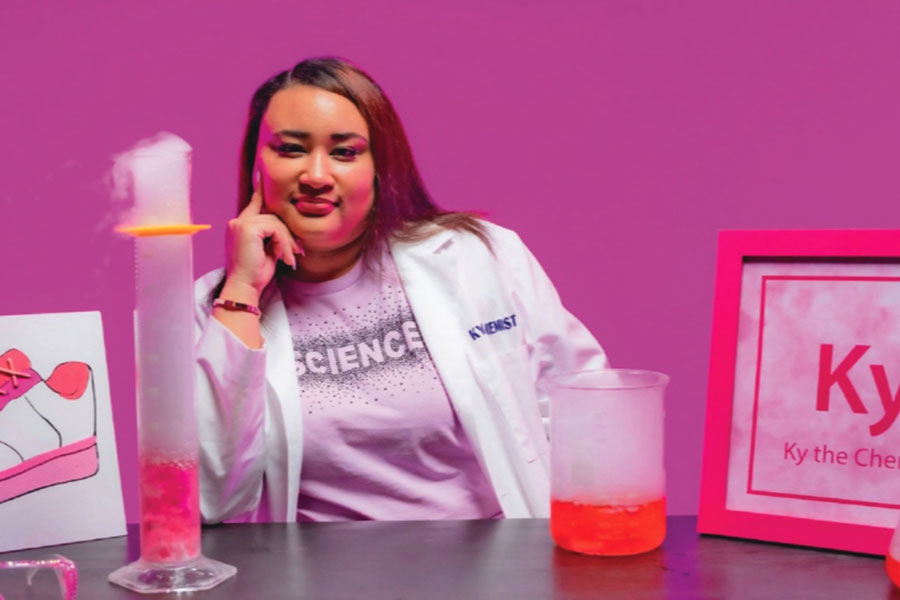
When Jakyra Simpson, MS’24, steps into a classroom to run one of her unique workshops, she can’t wait for one particular moment. She poses a question to the inquisitive students: “How many of you know the science behind your sneakers?”
Dead silence. Eyes trained on her like lasers.
“This is the time when I get extra excited,” says Simpson, better known as “Ky the Chemist”, a nom de plume she brings to her website and every social platform. “Now I’m able to tell them a story about the different materials of their shoes, the chemistry behind the glues, etc.”
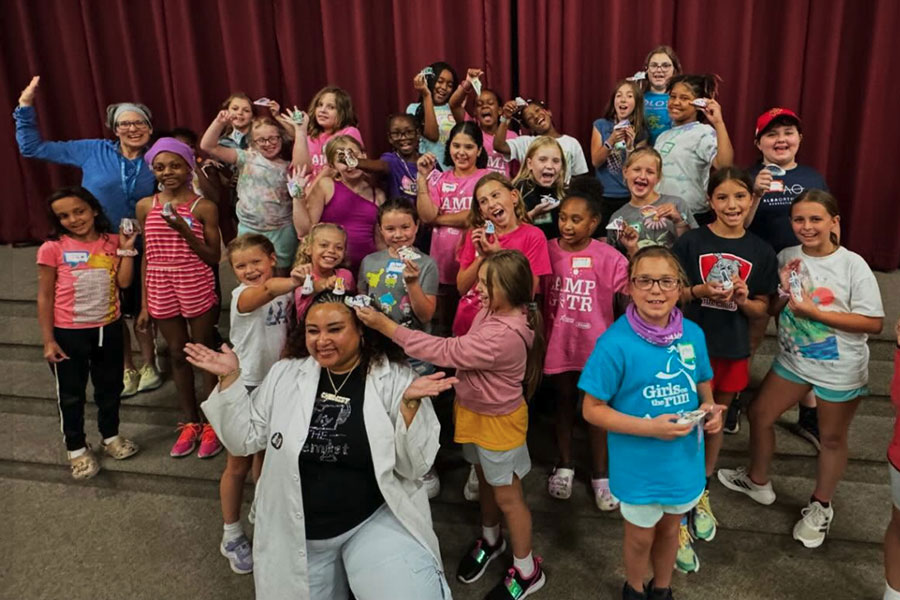
Ensuring science and technology is accessible to students in her hometown of York, Pa., has been Simpson’s focused mission for the past three years. Almost every day during the school year, teachers invite her to run K–12 workshops on how our shoes are constructed, giving students a deeper understanding of chemicals and material science and, more importantly, inviting them to become more curious about the world. She doesn’t just lecture but leads students to experiment with their own sneaker designs.
She’s visited every school in York, she estimates, but she has plans to expand her reach.
“This idea started as just that—an idea—but then it became a vision board and then a journal and now it’s this journey I’m on,” she says, “I know this idea is going to change the world.”
In the following Q&A, Simpson, who is also highlighted in the Spring 2026 IU Alumni Magazine, reveals how her workshops work, and why hip-hop culture can be a thrilling doorway to enliven science lessons.
Your workshops blend sneaker fandom with parsing through the science behind materials from glues to shoe deodorants, but what exactly do these classroom visits look like?
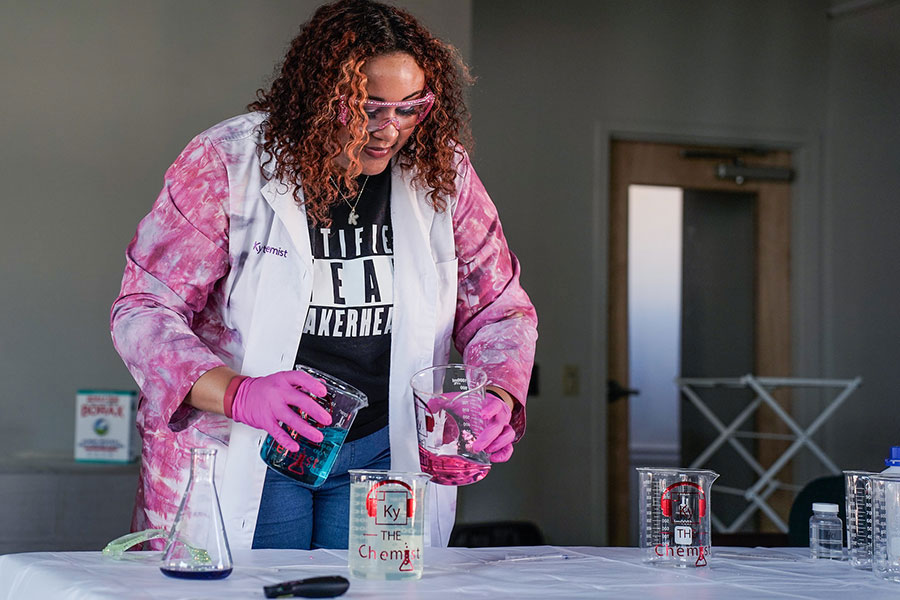
Jakyra Simpson: I center everything around experiential learning. How can I take chemistry, which people are usually not interested in, and make it more relatable? When I first began these workshops, I used a sneaker canvas board that broke down every element of a sneaker, from the insole to the laces to the glues, and I’d tell them about the different chemicals used to make each one. Then I’d ask them to take materials I brought and stick them onto the canvas board and make their own shoes, in a way.
I then moved on to let students use keychain sneakers as a model for them to design their own shoes. Picture a mini-Converse, for example. My lessons went from two-dimensional to three-dimensional. Students could use different adhesives to attach their own beads or sequins, for example, and I’d talk about the chemistry behind those glues.
What do you hear from students about your workshops?
JS: I see it live, thankfully. After one of my sessions, so many students come up to me and say they want to be sneaker scientists, or they want to be chemists when they grow up. I love when that happens. It’s so important for me to see and hear that kind of feedback.
Nearly two-thirds of the roughly three million U.S. students who enter college with the intention of majoring in STEM fields switch to non-STEM majors. What do you think motivates these students to leave STEM majors?
JS: As a woman of color in STEM, in a way I felt discouraged when I first got to university. There was no one that looked like me. And let’s admit it, imposter syndrome is a huge thing in those situations.
As an undergraduate, I felt disconnected from my material, I found it boring, but then I did what I’ve always tried to do, which is connect my experiences to what I’m learning. And I remember a class on pressure and different calculations, and there is this hip-hop song by Nas called “The Pressure,” and it made me connect to the material more.
That’s something I took to my workshops—I want to give students the chance to feel connected to what they’re learning, using their own experiences.
As a chemist, do you sometimes see the world differently? I mean, do you look at candy on Halloween and just think of Red Dye #40 as opposed to a bunch of gummies, or do you see a sofa as a hotbed of microplastics?
JS: For sure. I’m always asking questions when it comes to different products, like skincare or the food we eat, and I tend to try to understand every ingredient in what I buy. It makes me more mindful when I go out and shop.
I still love visiting sneaker stores because I’ll go through the aisles and then identify how they made that particular insole, or wonder which dyes were used to make that particular color scheme.
What’s next for you? I read you want to evolve your workshops beyond the classroom.
JS: Besides updating my YouTube channel to fill it with more content that I just filmed— which resembles Bill Nye the Science Guy episodes, but with what I do with kids—I have a new product launch. On my website, you can now get sneaker kits to do what I do in the classroom when I use small keychain sneakers as models. Parents can teach their children about the science of sneakers, which is at the heart of what I want to do—scale up the accessibility of this kind of science education.
Learn more about Jakyra Simpson’s passion for science teaching
Written By
David Silverberg
David Silverberg is a Toronto writer who regularly writes for BBC News, MIT Technology Review, The Globe & Mail, and Princeton Alumni Weekly.