When Windows Told Stories: Display Artist Keeps the Magic of Retail Art Alive
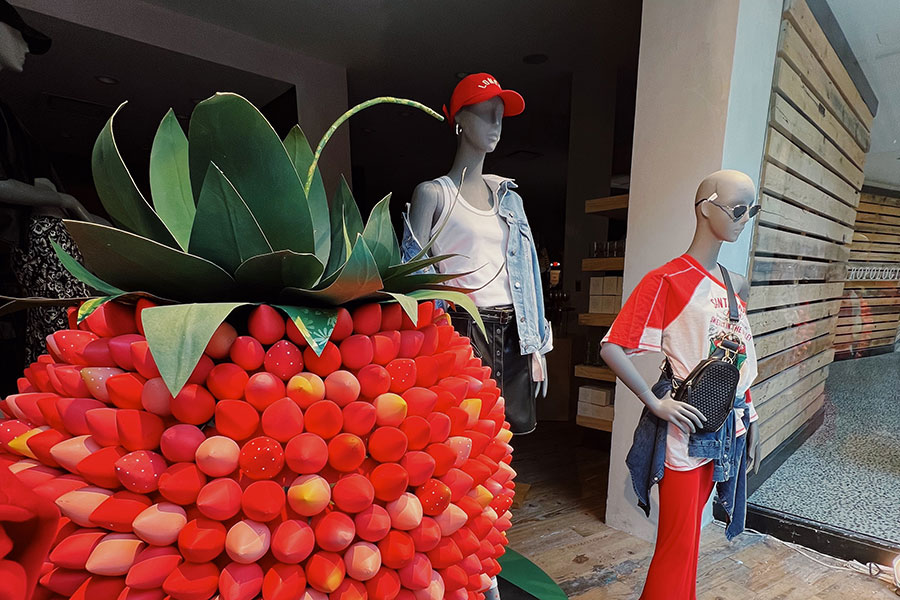
Anthropologie at the Fashion Mall at Keystone in Indianapolis is a destination for two reasons. One, it’s the only Anthropologie location in the state of Indiana, and two, it’s an art exhibit that changes seasonally thanks to the store’s resident display artist, Meghan Curran, BFA’20.
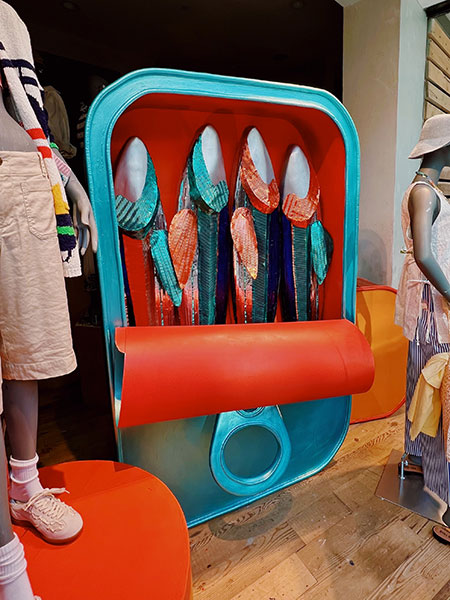
Curran created a can of sardines for Anthropologie’s summer 2025 display.
“The sardines themselves are purple foam and paper, and the tin itself is mostly plywood,” she says. “It took a couple of weeks, probably way longer than it should have. Had I had time, I would've loved to have painted a cute label on the tin that said something like, ‘Circle City Sardines.’”
Photo courtesy of Meghan Curran.
Store window displays have a fascinating history unknown to many shoppers. The invention and mass production of large plate-glass windows in the mid-1800s transformed shopping. Suddenly, stores could show off their merchandise to passersby in big, eye-catching ways.
At first, windows were relatively straightforward—clothes neatly arranged, sometimes with props like parasols, hats, or chairs. The focus was more on inventory than narrative.
European department stores like Le Bon Marché in Paris and Harrods in London were early leaders in treating windows as mini art displays. Then came the Golden Age of window displays in the 1920s.
Stores like Bergdorf Goodman and Saks Fifth Avenue hired full-time display directors. Artists used sculpture, murals, and installations to frame clothing, almost like works in a gallery.
Now, with fewer people browsing malls for clothes and opting to shop online, window displays have become less of a sales driver, and most companies no longer have a line item in their budgets for display teams.
Curran says Anthropologie is one of the only retailers that still places real value on the role of art in merchandising.
“I get comments from people who worked for [stores like] Macy's back in the ’80s and loved seeing the displays. They always say, ‘I wish that more stores still did this,’” she adds. “Display art creates a much more welcoming experience for customers versus marketing banners or displays that are mass-produced and shipped out.”
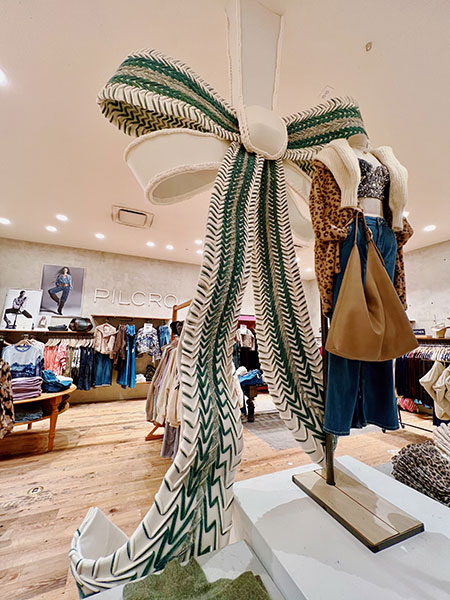
The giant bow Curran created for the holiday display in 2024 weighed roughly 40 pounds.
“Sometimes our displays are more accessible to the customer and their kids, and the tails of the ribbon definitely were,” she recalls. “I was [slightly] worried that it might come down if someone were to just give it a yank.”
Photo courtesy of Meghan Curran.
Anthropologie still budgets for display artists, but at the Keystone store (and most other Anthropologie locations), Curran is a one-woman team juggling a hefty workload.
“We do four window displays per year. We also have rotating displays throughout the sales floor [year-round],” she says.
Today, store windows aren’t just for passersby—they’re built to be Instagrammable. A display is judged not only by foot traffic but by how widely it’s photographed, shared, and tagged online.
Since she started working at Anthropologie in 2023—first at a store in Santa Rosa Beach, Fla., and now in Indianapolis—her social media following has skyrocketed. She has more than 124,000 followers on Instagram, and more than 57,000 people follow her on TikTok.
“The love for my Anthropologie content has been incredible,” Curran says. “I get a lot of comments from people being like, ‘I didn't even know that this could have been a career option for me.’”
Curran’s first window display was a hometown project unrelated to Anthropologie. In 2021, she was one of nearly 600 Indiana-based artists selected by the Indy Arts Council to create art installations for Swish—a three-week cultural festival that ran in concurrence with the NCAA men’s basketball tournament.
Curran’s piece Play, 64 brightly colored basketballs strung vertically in a window on Washington Street in downtown Indianapolis, got major attention on social media and was featured in The New York Times.
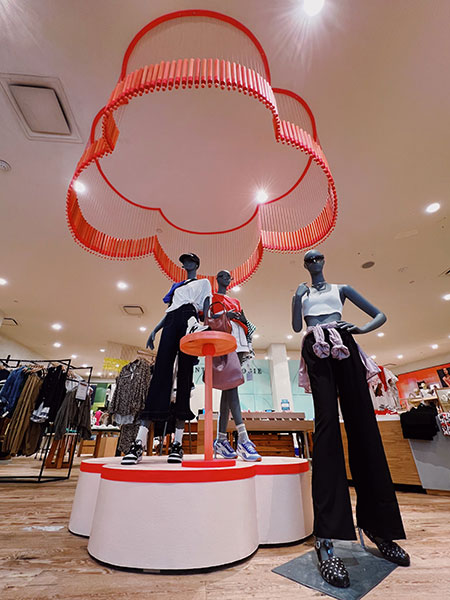
Curran’s flower-shaped chandelier was made of 208 wooden dowels, which were repurposed from an old Anthropologie display.
“The widest point of the chandelier was 9 feet, and all the dowels and beads were dyed by hand,” she says. “The matching platform and accessories stand were also both built by me.”
Photo courtesy of Meghan Curran.
These days, anchoring strings of basketballs from a ceiling would certainly be a breeze for Curran, who has moved on to much bigger installations for Anthropologie, including a flower-shaped chandelier made of 208 wooden dowels.
“Now, I feel like I’m able to judge how long things will take, how many supplies I will need, and I just work a lot quicker,” she says. “I had no idea how much paint I’d actually need when I was making Play, so I was running to the hardware store literally every day for more.”
Curran’s job seems incredibly niche, but the prerequisites for the role are actually very broad. She works with every medium under the sun—painting, ceramics, woodworking, sculpture—and says most display artists working for Anthropologie come from a variety of backgrounds.
“I feel like I’m constantly learning at this job,” adds Curran, who specialized in drawing and illustration at the IU Herron School of Art + Design and has fully embraced the saying “jack of all trades, master of none, though oftentimes better than master of one.”
Curran’s current medium of choice is foam carving. For the spring 2025 window display, she built the now-viral strawberry by layering and shaping large sheets of foam into the fruit’s form. After coating it in plaster, she carved and hand-painted 600 Styrofoam eggs, attaching each one individually to complete the piece.
“It took me a couple of months to complete, but it was really worth it,” Curran says.
Chipboard is another material Curran seems to use for almost every display. The fine cardboard material was used to make the strawberry’s leaves, as well as the giant bow she created for winter 2024’s holiday display.
To create the bow, Curran covered the chipboard in fleece and spent roughly 40 hours punching holes and threading yarn through the 13-foot display.
“It was so heavy. Heavy enough that I was like, ‘I wish I knew a little bit more about physics and engineering to know if this is structurally sound in our ceiling,’” she recalls.
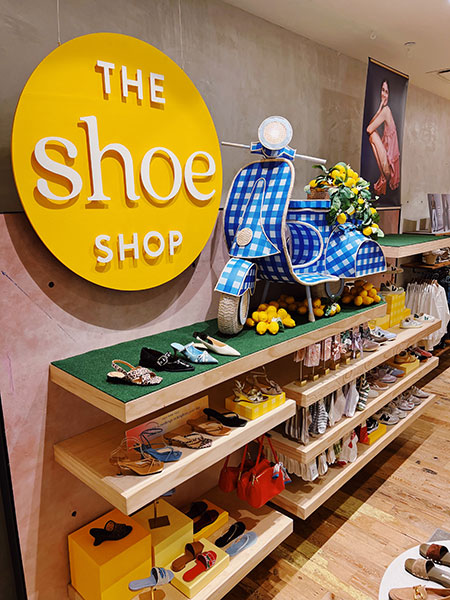
Before the Vespa was used for the summer 2025 display, it was part of Anthropologie’s holiday décor in 2024.
“For holiday last year, I crocheted the entire body, including the wheels,” Curran says. “It also has a headlamp that turns on, which was really cute.”
Photo courtesy of Meghan Curran.
Some store displays get reused, but when they’re no longer needed, Curran likes to find places for her art that aren’t the dumpster. The Vespa she painted in blue gingham with hand-woven wicker wheels was donated to St. Malachy Catholic School in Brownsburg, Ind.
Curran oversees all material sourcing, and whenever possible, she enjoys weaving in a quiet nod to her city. For a summer 2025 chandelier, she gathered 146 wine bottles from the JW Marriott in downtown Indianapolis.
“One of my goals is to add a local touch to every display,” she says. “I want our clientele to be like, ‘Oh my gosh, that's custom just for us.’”
However, the Herron alum doesn’t have total creative freedom in her role as a display artist. Themes for each season come from corporate so that every Anthropologie store around the globe looks cohesive. Curran acknowledges that some artists would find it difficult to work under these strict constraints.
“I think both sides [of the argument] are valid,” she says. “What I like is that this job allows me to learn all these mediums while [providing] me with a consistent income. I’ve worked for myself. Now, the art I make outside of work is just for fun, and it doesn’t have to be so high stakes.”
Written By
Samantha Stutsman
Samantha Stutsman, BAJ’14, is a Bloomington, Ind., native and freelance writer. She has written for publications including PEOPLE, Indianapolis Monthly, and the IU Alumni Magazine.