Make an impact
Donation Drive Guide
Directions
Want to support people in need by volunteering in your community? A donation drive is a great way to help others. Here's a step-by-step guide for how to set up, organize, and run a successful donation drive:
- Set up your goals: Determine which type of service project you'd like to run and how many items you hope to collect.
- Pick a duration: Set the time frame for the drive. We recommend aligning the drive with the season—for example: school supplies in July or August, coats and winter items in November, etc.
- Promote the event: Create flyers or social media posts to spread the word. Include the drop-off location, dates, and details on acceptable donations.
- Set up collection bins: Print flyers and affix them to boxes. Provide clearly labeled bins or boxes where people can drop off their donations and place them at your workplace, community center, schools, etc.
- Donate or distribute: Coordinate with the organization you are donating to for drop off and distribution of the items collected.
- Thank participants: Show appreciation to everyone who contributed, either through personal thank-you notes or social media posts and shout-outs.
- Share the impact: Let us know the results of your service project by posting on social with the hashtag #IUalumni or emailing iueditor@iu.edu with pictures and your story.
Service kits
Directions
Creating your own "kits" for a service project is a wonderful way to give back to the community. Below are suggestions for how you can go about it—including some suggestions for items to include in each type of kit and ideas for places to donate them.
- Gather materials: Start by collecting the items listed for each kit. Consider reaching out to friends, family, or local businesses for donations.
- Find your donation site: Contact the organizations you want to donate to and confirm their needs. Some places might have specific guidelines (like size of items or types of products). They may also provide recommendations for where the kits will have the most impact.
- Assemble the kits: Once you have all the items, pack them into appropriate containers (like sturdy bags, boxes, or baskets). Label them clearly and make sure everything is securely packed.
- Drop off or distribute the kits: Arrange a drop-off time with the organization. If you prefer, you can organizing a small community event to distribute the kits.
By creating these kits, you can make a tangible difference in someone's life, whether it's offering comfort during a tough time or providing the necessities for a brighter day. Thank you for contributing to such a meaningful cause!
Cancer care kit
Suggested items include:
- Comfort items: Soft socks, cozy blankets, or shawls
- Entertainment: Coloring books and crayons, crossword puzzles, or small journals
- Self-care: Lip balm, hand lotion, soothing teas, or ginger candies (to help with nausea)
- Practical items: A reusable water bottle, moist towelettes, or sanitizing wipes
Possible donation locations include:
- Local hospitals or cancer treatment centers
- Cancer support organizations or foundations
- Hospice care centers
Homelessness kit
Suggested items include:
- A sturdy, reusable water bottle
- Granola bars or non-perishable snacks
- Hand sanitizing wipes or soap
- A small first aid kit (bandages, antiseptic wipes)
- A pair of socks and gloves (especially in cold weather)
- A travel-size toothbrush, toothpaste, and deodorant
Possible donation locations include:
- Homeless shelters or outreach programs
- Soup kitchens or community kitchens
- Street outreach teams that support homeless individuals
- Community centers that run programs for homeless people
Food drive
Suggested items include:
- Canned goods
- Peanut butter
- Pasta and rice
- Boxed cereal and oatmeal packets
- Dried fruits, nuts, and seeds
Possible donation locations include:
- Shelters for homeless families or children
- Local food or community kitchens
Hygiene kit
Suggested items include:
- Travel-sized shampoo or conditioner
- Bar soap or body wash
- Toothbrush and toothpaste
- Deodorant
- Feminine hygiene products (pads, tampons)
- Comb or brush
- Hand sanitizer
Possible donation locations include:
- Domestic violence shelters or women's shelters
- Homeless shelters
- Refugee or immigrant support organizations
- Low-income family services or food pantries
Rope toy craft
Have old, unwanted T-shirts taking up space in your closet? A great way to recycle those unwanted T-shirts is to turn them into a rope toy for dogs. The steps are easy to follow, and all you need is your old shirt and a pair of fabric scissors. Normal scissors will work, too.
Supplies
- Old T-shirt
- Fabric scissors
- Rope (optional)
Instructions
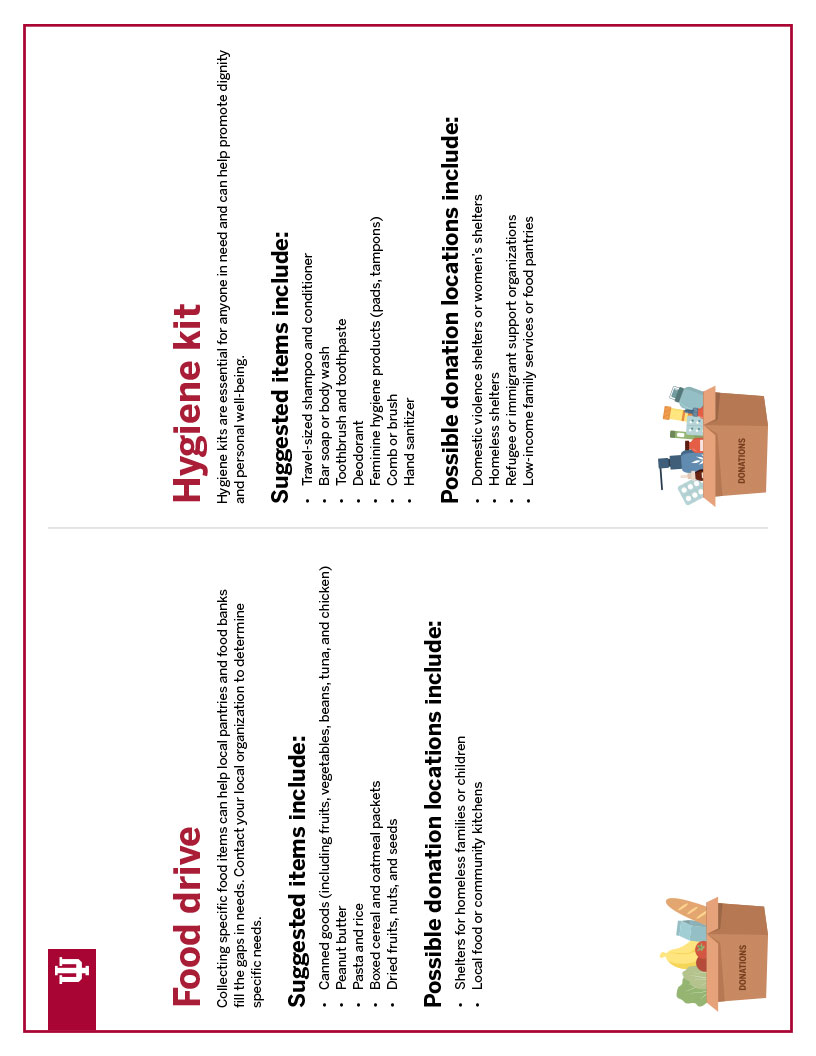
- Lay your shirt out on a flat surface. Cut off the collar, bottom seam, and arm seams. Cut off sleeves and put to the side for later.
- Cut shirt in 1 - 1 1⁄2 inch strips and place the strips into a pile.
- Cut the sleeves in half so they become a long rectangle. Cut the fabric into strips and place into a second pile.
- Grab one strip, cut it in half, and tie it around the top of one pile of strips.
- Braid the shirt strips, tie off the bottom like you did for the top in the previous step, then cut off any excess.
Donate your new rope toy to a local animal rescue or shelter.
Bouquet card
Instructions
- Cut out the card along the dashed lines.
- Fold the right and left flaps back along the solid gray lines and tape to the back.
- Write a short message on the front and deliver the bouquet.

Coloring page