Tech with a Heart
Entrepreneurs, by one simple definition, identify problems and find novel ways to solve them.
Here’s a problem: As millions of functional computers and electronics are discarded each year, countless students and families lack access to technology they need for education, work, and daily life—they are on the wrong side of the “digital divide.”
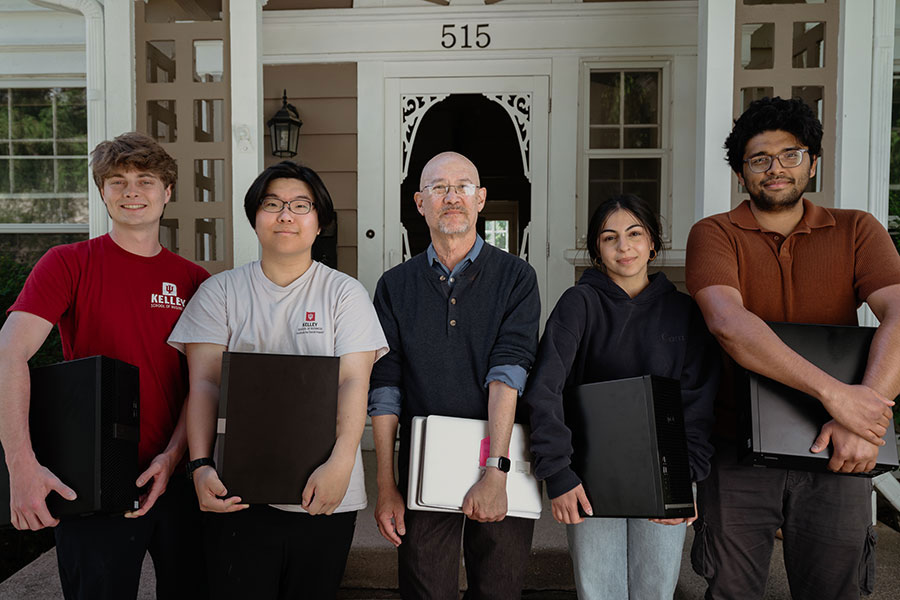
Enter recent IU graduates Jack Wilber and Mary Dinkha, both budding entrepreneurs, who are addressing that important societal issue. With some help from IU, including IU Innovates, their startup company, Binary Heart, has grown significantly and is helping to solve the problem.
The story of their effort begins in 2018, when Wilber was a high school student in the Chicago suburbs. He joined a school club, Binary Heart, that had formed to help close the digital divide by collecting and redistributing technology. It also taught students valuable skills in hardware repair, data security, and systems administration.
“I loved it,” Wilber says. “It was wonderful. I got to play with computers and build stuff.” The club was having modest success toward its mission, donating 20 to 30 devices a year, he says.
Growing the Concept
Wilber graduated and headed to IU, and by sophomore year he found that he was missing Binary Heart and the purpose it provided him.
So he went back to his high school—New Trier High School in Winnetka, Ill.—and pitched the idea of growing the Binary Heart concept. He would start a not-for-profit organization named Binary Heart. Its first chapter would be at New Trier, and the second chapter would be at IU Bloomington. The advisers at New Trier agreed, and Wilber was off and running.
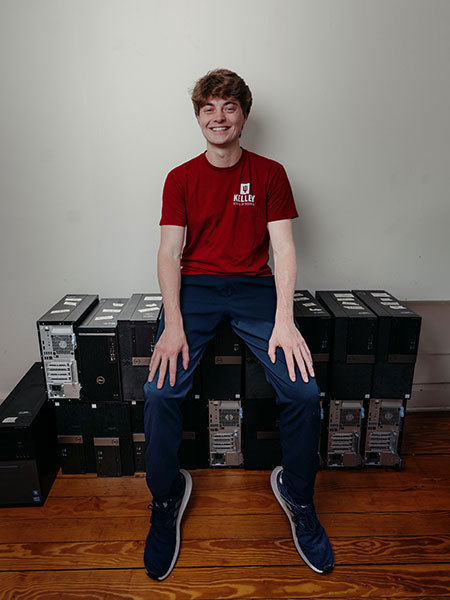
For a year, he was the sole member of the IU chapter, and his apartment—“stacked with computers”—served as the workshop. Despite the limitations, he was able to donate nearly 100 computers to those who needed them. The computers that he refurbished came from the corporate donations, the city of Bloomington, and people in the community.
After that first year, he recognized that it was time to formalize and expand the effort. Dinkha was one of the first to come aboard.
“[Some people’s lack of access to technology] is not really something that you think of in a day and age where technology is so prevalent,” says Dinkha, who also attended New Trier High School but wasn’t part of the Binary Heart club, “But you realize they’re at a disadvantage.”
Access to technology and the skills that go with it benefit people in numerous ways. For example, students gain access to vast online educational resources, job seekers find employment more efficiently, and those with healthcare needs tap into telehealth services.
Another early addition to Binary Heart was Enzo Caggiano, who was attending Northwestern University and started a chapter there. Today, Wilber is Binary Heart’s president, while Dinkha and Caggiano, as well as Henly Wolin, serve as executive directors. Amy Kemper rounds out the board
The IU Effect
As Binary Heart has grown—and seeks more growth—the team has leaned into IU resources.
Wilber credits the coursework and professors at the Kelley School of Business for improving his business acumen, and he notes that many of the volunteer students come from the Luddy School of Informatics, Computing, and Engineering.
Another important contribution from IU has been a dedicated space on campus, which was provided by IU’s Ostrom Workshop.
“That was a great gift,” Wilber says. “We have a nice big workshop and then our basement is our storage area.”
Financially, he estimates that the organization has received a total of $50,000 from a variety of IU sources.
And, through IU Innovates, the university provides critical support and guidance to student and faculty entrepreneurs, including Binary Heart.
Julie Heath, executive director of IU Innovates, says that advancing IU entrepreneurs “from learning to launching is the north star of our work.”
Each semester, more than 250 students—freshmen through PhD candidates—are part of the IU Innovates program. Those students are led through the program by five full-time staff members and about 20 part-time staff members. The part-timers include IU alumni with entrepreneurial experience, known as Founders in Residence, and current IU students, known as Community Managers.
The support from IU Innovates and other IU entities underscores one of the aspirations of the Never Daunted campaign: strengthening communities across Indiana and beyond. IU innovates equips students and faculty with entrepreneurial skills that help them launch businesses and drive innovation that benefits society.
For Heath, Binary Heart is a great example of how IU Innovates can add value to an entrepreneurial endeavor.
“That’s a situation where [the founders] are figuring out who cares deeply about this problem being solved,” Heath says.
She notes that with Binary Heart there are multiple types of people and organizations who could care deeply about its mission.
“They might have foundations that care about digital access and literacy,” Heath says. “And then there might be the individuals who say, yes, I want that refurbished device.”
Sharpening that understanding of those people and organizations is an important learning experience, she says.
Dinkha says the guidance from IU Innovates has been “invaluable.”
“[The staff] has been in similar shoes, leading a project or a passion or an organization that really requires jumping over hurdles—hurdles that you’ve never really come across before.”
IU Innovates—and the other IU entities that have provided support—have helped expand Binary Heart’s impact.
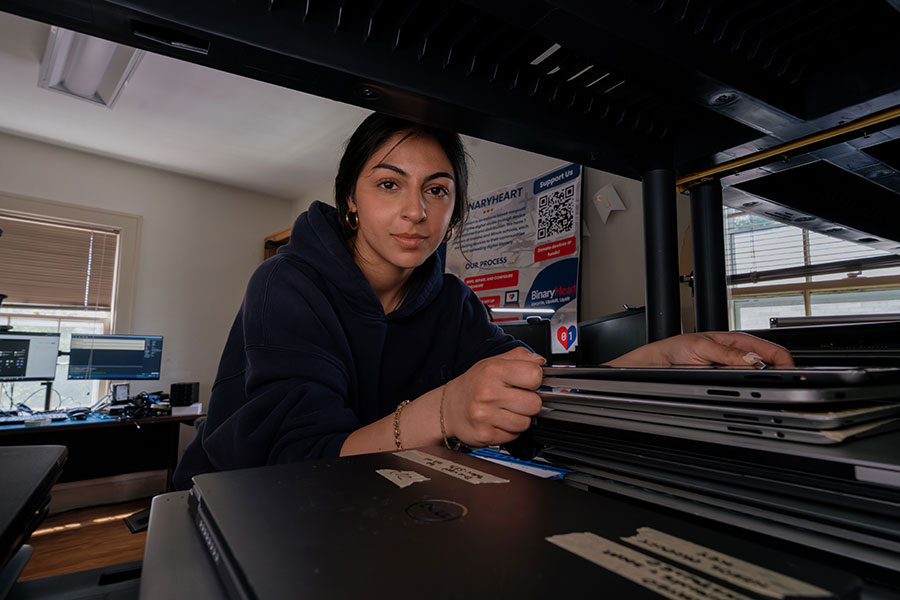
From a one-man show in Wilber’s apartment, the organization has grown to comprise seven chapters at universities and high schools in Indiana and Illinois with more than 130 student volunteers, including nearly 50 members of the IU chapter. Across all of the chapters, the total value of the devices donated so far is about $90,000.
The Future
Dinkha and Wilber both graduated in May 2026, and they are eager to apply what they’ve learned to their next chapters.
For Dinkha, if she had been asked six months ago, she would have said she would go straight into a PhD program. But her experience with Binary Heart has shifted her thinking—she’s open to other options.
“It’s still a lot of figuring out, but the one thing I do know is that I really do love the people that I work with,” she says. “If I can stay working with them for as long as possible, that would be pretty much my ultimate goal.”
Wilber has established a software studio with three products, two of which he developed for use with Binary Heart. He’s brought on product managers, salespeople, and engineers, and he’s hopeful that it will prove a financial winner.
His work as president of Binary Heart will also continue.
“It’s one of the most wonderful things that I work on,” Wilber says. “I don’t want to lose that.”
Written By
J.D. Denny
J.D. Denny, BS’90, MA’01, is director of content for the IU Alumni Association and editor in chief of the IU Alumni Magazine.