Indiana Born and 'Bread'
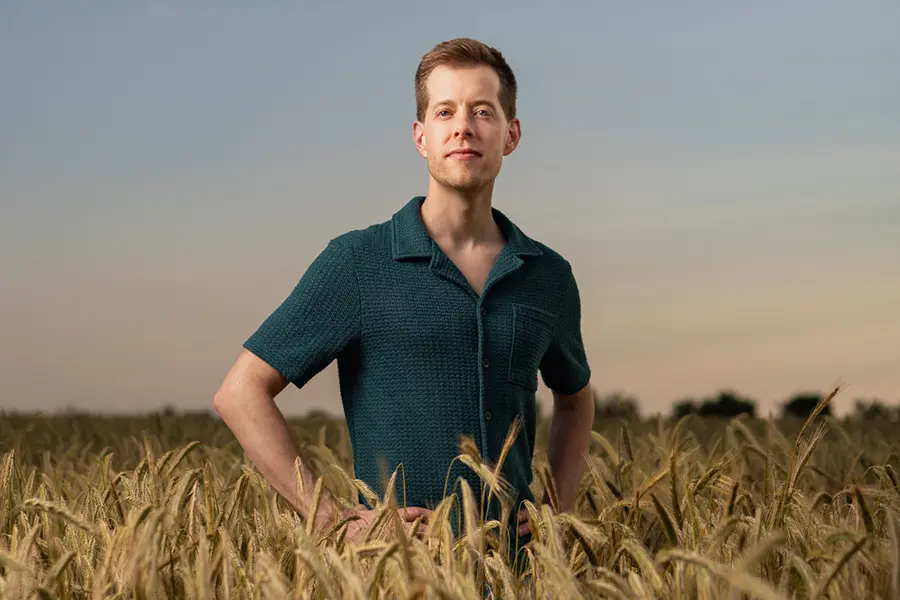
When Martin Sorge, BA’07, MPA’11, was at IU, the English major could never have predicted he’d one day write a cookbook. Back then, he was a self-proclaimed “bad baker.”
Nearly two decades and two IU degrees later, Sorge found himself back in Bloomington on tour for his debut cookbook, Great Bakes. In between those two moments came a baking obsession, years of practice, and winning the Great American Baking Show—an international spotlight most home bakers only dream of.
But Sorge’s connection to food started long before the cookbook or his baking show victory. Growing up in Fort Wayne, Ind., he says he was raised to be “the least pretentious kind of foodie.”
His family, as he tells it, ate sweet corn every day when it was in season and put a plain tomato slice on a sandwich when the tomatoes were good. That appreciation for simple Midwestern staples laid the foundation for his love of food.
The kitchen became a familiar playground, where he improvised ingredients for soups and added his own flair to dinners he made for friends. As an undergraduate at IU Bloomington, he worked at Oliver Winery, a job that taught him to really taste with all of his senses and how to pair food more intentionally.
Still, cooking and baking, he’s quick to point out, are not the same skill.
“I actually was a really bad baker,” he says.
He specifically remembers a batch of cookies he made as a graduate student to share with his O’Neill School classmates that had to be thrown out. “They tasted like dog food,” he recalls.
Years later, that failure led to a deceptively simple realization. “I said, ‘I bet if I get a cookbook, measure the ingredients, and follow the recipe, it’ll work.’ You know what? It did. It does.” With that in mind, he made an edible loaf of no-knead bread.
That successful loaf of no-knead bread unlocked an obsession. Every cake, every pastry, every cookie—Sorge wanted to bake it all. And soon, he was baking his way toward a new goal: competing on the Great American Baking Show.
Getting there took persistence. Sorge put himself through the show’s demanding application process multiple times over several years before he was finally cast. Once he was in the tent, though, the experience matched the expectations he had as a fan.
“It’s exactly like you think it is,” he says. “There are no weird behind-the-scenes secrets.”
The judges, he adds, are warm and generous with feedback, even under pressure. During Sorge’s “bread week,” that pressure was literal: Temperatures in the tent climbed into the high 90s during an unprecedented UK heat wave, causing his dough to proof faster than he wanted.
“You have to really know what you’re doing.”
Despite the bread debacle, Sorge emerged from the infamous white tent victorious.
Winning the show might seem like the obvious launchpad for opening a bakery. But a bakery wasn’t a dream he had. Sorge had spent years working closely with small businesses in his previous job—restaurant owners, bakery owners, people who lived and died by razor-thin margins. He’d heard enough stories to know that owning a bakery wasn’t for him. And Chicago, his home for the last 15 years, wasn’t exactly hurting for another storefront.
What he did have was a drawer full of recipes he’d been perfecting for years in the lead-up to his Great American Baking Show debut: pillowy cinnamon rolls, hearty whole wheat bread, melt-in-your-mouth pie crust. That collection became the backbone of his book, Great Bakes.
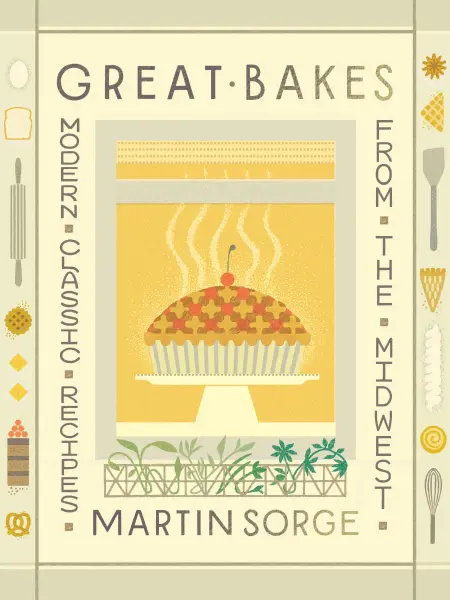
Great Bakes is, in many ways, an homage to the Midwest—and to the food that first shaped Sorge’s palate. The opening recipe is an apple crisp he feels encapsulates his Indiana upbringing, inspired by the bushels of apples his mother used to bring him and his roommates in Bloomington. There’s a cherry Pop-Tart recipe built around Michigan’s notable tart cherries, sweet corn shortbread, and a pie crust simple enough that Martin claims he can walk into anyone’s kitchen and make it from ingredients everyone keeps in their pantry.
In crafting Great Bakes, Sorge kept beginner bakers in mind. Carefully paced, each chapter starts with the easiest recipes and gradually builds in difficulty, easing readers into more ambitious bakes as they turn the pages.
Generous with his knowledge, Sorge shares plenty of practical advice for home bakers, including something so obvious, it’s often missed: Buy a kitchen scale.
“A cup of flour could be 110 grams or 160 grams, and that can change your bread or cake vastly,” he says—a lesson that, he notes, traces all the way back to overcoming his own fear of numbers in graduate statistics courses at IU.
Today, Sorge is still finding new ways to push his baking further. As if his book tour wasn’t keeping him busy enough, he’s currently studying for his final exam to become a certified bread sommelier at Germany’s National Baking Academy. But no matter how far his baking takes him, we know Sorge’s recipes will always taste a little like home.
In the Kitchen with Martin
Ready for a great baking challenge? Give Martin’s apple crisp recipe a try.
Written by
Tara Tadlock
Tara Tadlock is a Marketing Writer at the IU Foundation. She is also a freelance writing with work published in Mashable, Budget Travel, Elite Daily, and more.